The Hidden Failure Mode of Self-Priming Solenoid Valves: How the WH-ZJ01-409 Aging Tester Protects Your Brand
Here is a scenario familiar to anyone who has dealt with solenoid valve field failures:
The valve works perfectly in production testing. The coil reads the correct resistance. When you apply power, it clicks. It passes electrical go/no-go testing. But after 10,000 cycles in the field – or sometimes 10,000 miles, or 10,000 washing machine cycles – it fails. Intermittently. Unpredictably. Expensively.
The problem is not that the valve is “bad.” The problem is that standard electrical testing cannot predict mechanical wear.
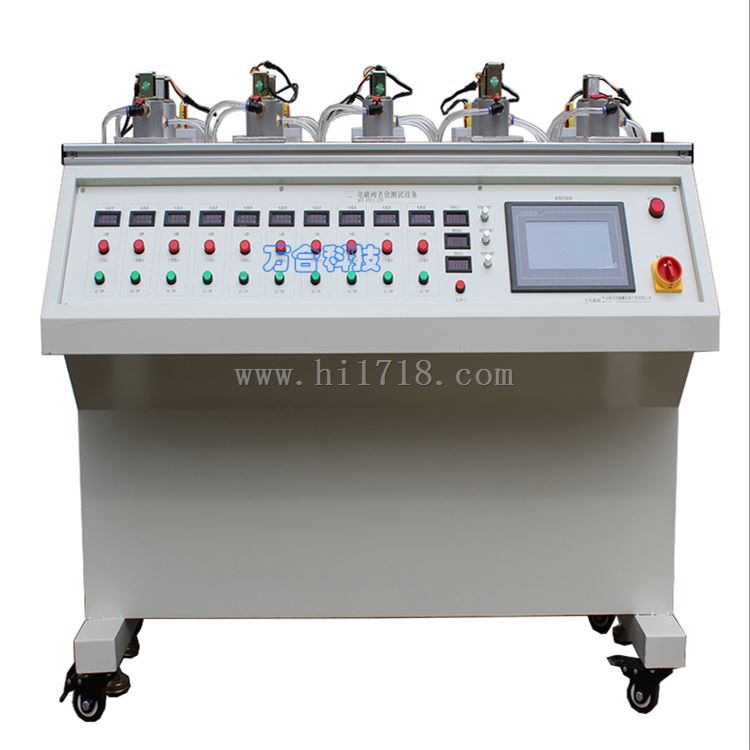
The WH-ZJ01-409 Self-Priming Solenoid Valve Aging Test Equipment from Zhongshan Wanhe is designed to catch these hidden failure modes before your product ships. This article explains the business case for bringing aging testing in-house.
The Three Hidden Failure Modes of Self-Priming Valves
Failure Mode 1: Pull-in Voltage Drift
Over thousands of cycles, the plunger may become harder to move (wear debris, slight corrosion, spring fatigue). The voltage required to pull in the valve increases gradually.
Electrical test at time 0: Valve pulls in at 18V (rated for 24V) – passes with margin.
After 50,000 cycles: Valve now requires 23V to pull in – still passes at 24V, but margin is gone.
After 80,000 cycles: Valve requires 25V – fails at rated 24V.
Without aging testing, you never see this drift. With the WH-ZJ01-409, you can measure pull-in voltage at intervals (e.g., every 10,000 cycles) and track degradation.
Failure Mode 2: Holding Current Creep
As the coil insulation degrades or the magnetic circuit changes, holding current may increase. Slightly at first – then dramatically.
Result: The control board’s driver transistor overheats. The board fails – but the valve gets blamed. Field service replaces the valve, but the real problem (excessive holding current) remains.
The WH-ZJ01-409 monitors holding current with a 3.0A overcurrent alarm. If current creeps up over cycles, you see it in test data.
Failure Mode 3: Mechanical Stick/Slow Response
The valve “clicks” electrically, but the plunger moves slowly or incompletely. Air flow is delayed or restricted.
Electrical test: Pass (coil draws current, continuity good).
Functional test: Fail (air flow doesn’t start on time, or doesn’t stop completely).
The WH-ZJ01-409 includes compressed air verification – it detects whether air flows when the valve should be open and whether air is blocked when closed.
The Cost of Not Testing
Let’s quantify what these hidden failure modes cost:
| Failure Mode | Field Symptom | Typical Warranty Cost per Incident |
|---|---|---|
| Pull-in voltage drift | Valve won’t open – no gas/water flow | $150-300 |
| Holding current creep | Control board failure – valve blamed | $200-400 |
| Slow response | Intermittent operation – hard to diagnose | $250-500 (multiple service calls) |
Now consider a 1% failure rate on 100,000 units:
| Scenario | Failures | Cost per Failure | Total Warranty Cost |
|---|---|---|---|
| No aging testing (1% field failures) | 1,000 | $200 (avg) | $200,000 |
| With aging testing (catch 80% before shipment) | 200 | $200 | $40,000 |
| Annual savings | 800 failures prevented | $160,000 |
The WH-ZJ01-409 pays for itself many times over – typically in 3-6 months.
Key Business Features of the WH-ZJ01-409
Feature 1: 5 Stations = 5x Throughput
Without 5 stations, testing 100 valves takes 100 sequential runs. With 5 stations, it takes 20 runs.
Business impact: Your quality team qualifies suppliers faster, validates design changes faster, and audits production faster. No more waiting weeks for test results.
Feature 2: Individual Station Failure Detection
When a valve fails on a typical multi-station tester, the whole test stops. You lose data from the other stations.
With the WH-ZJ01-409: Only the failed station stops. The other 4 continue testing.
Business impact: No wasted test time. If one sample fails at 60,000 cycles, the others continue to 150,000 cycles – giving you full data on mean time between failures (MTBF).
Feature 3: Countdown Mode with Auto-Lockout
Set the master counter to countdown mode at 100,000 cycles. Start the test. Walk away.
When target is reached:
-
System stops automatically
-
Audible/visual alarm sounds
-
System locks out – no over-testing
-
Press “Reset” to unlock
Business impact: Operators don’t need to watch the test. Tests run unattended overnight or over weekends.
Feature 4: Power Failure Memory
Aging tests run for days or weeks. Power outages happen.
The WH-ZJ01-409 retains all settings and accumulated counts after power loss. When power returns, testing resumes from where it stopped.
Business impact: No wasted test time. No “we were at 95,000 cycles when the power went out” frustration.
Feature 5: Adjustable Mounting Positions
Each station’s mounting fixture can be adjusted left/right and forward/backward.
Business impact: One tester handles different valve form factors. No need for custom fixtures for every valve type.
Feature 6: Wide Operating Temperature Range (-25°C to +85°C)
The WH-ZJ01-409 operates in harsh factory environments. No special air conditioning required.
Three Business Cases
Case 1: Supplier Qualification – Finding the Best Long-Term Value
A gas appliance manufacturer sources self-priming valves from three suppliers. They test 10 valves from each on the WH-ZJ01-409 for 200,000 cycles.
Results:
-
Supplier A: All pass, pull-in voltage stable (±2%)
-
Supplier B: All pass, but pull-in voltage drifts +15% after 150k cycles
-
Supplier C: 2 fail at 90k cycles (won’t pull in)
Decision: Supplier A is qualified. Supplier B is qualified with tighter monitoring. Supplier C is rejected.
Annual impact: Using Supplier A instead of the lowest-cost supplier (C) costs $0.20 more per valve (100,000 valves = $20,000). But avoiding Supplier C’s 20% failure rate at 90k cycles prevents $4,000,000 in potential warranty claims.
Case 2: Design Validation – Catching a Coil Problem Early
An engineer designs a new low-power solenoid coil. Initial bench tests pass. The WH-ZJ01-409 runs 50,000 accelerated cycles.
Finding: Holding current increases from 0.8A to 2.1A over 50,000 cycles – approaching the 3.0A alarm limit. The coil insulation is degrading.
Action: The engineer specifies higher-temperature magnet wire. Retest shows stable holding current for 200,000 cycles.
Avoided cost: If the original design went to production, field failures would have started after 18-24 months – warranty claims estimated at $500,000+.
Case 3: Production Audit – Containing a Bad Batch
A manufacturer tests 5 valves per week from production on the WH-ZJ01-409 (5,000 cycles each, 24-hour accelerated test). One week, 3 of 5 valves fail pull-in under 5,000 cycles.
Investigation: The supplier’s production line had a calibration error on the coil winding machine. Only one shift was affected – 2,500 valves.
Action: The 2,500 suspect valves are quarantined and retested. 800 are rejected. The problem is contained before any reach customers.
Savings: 800 field failures prevented × $200 = $160,000 saved – on one incident.
Total ROI Summary
| Benefit Category | Annual Savings Estimate |
|---|---|
| Prevented warranty claims (supplier qualification) | $100,000 – $500,000 |
| Prevented design-related field failures | $50,000 – $200,000 |
| Production audit – catching bad batches | $50,000 – $150,000 |
| Reduced test time (5x throughput) | $20,000 – $50,000 (labor) |
| Typical total annual savings | $220,000 – $900,000 |
Why Zhongshan Wanhe?
Zhongshan Wanhe Testing Equipment Development Co., Ltd. brings over 9 years of experience as a certified Gold Supplier. Their specialization includes:
-
Wall-mounted furnace testing equipment
-
Appliance performance testers
-
Environmental chambers
-
Custom test solutions
Factory-direct pricing means professional-grade equipment without distributor markups.
Conclusion
Self-priming solenoid valves have hidden failure modes – pull-in voltage drift, holding current creep, and mechanical stick – that standard electrical testing cannot detect. The WH-ZJ01-409 Aging Test Equipment reveals these failures before your product ships.
With 5 independent stations, adjustable pull-in and holding voltages (0-30V), programmable timing, compressed air verification, overcurrent protection, and power failure memory, the WH-ZJ01-409 is a complete solution for self-priming valve durability testing.